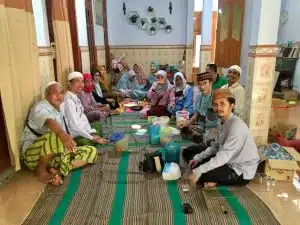
The third post in our alumni profile series for the 20th year of AIMEP is about Syamsul (Sam) Arif Galib, an inspiring young leader from Makassar, Eastern Indonesia and alumnus of the 2017 AIMEP. Sam is committed to building understanding and friendship between people from different faith communities.
Read his story below:
Syamsul Arif Galib

I studied for six years in a Pesantren, an Islamic boarding school. Although I learned about other faiths in that school, I never had any actual encounters with anyone different. And later, while I was at university, I had a feeling of superiority because of my religion being in the majority.
But when I went to study in the US, I understood for the first time how it felt to be in a minority. And I also realised that having friends from other religions was not a problem. For example, I had a Christian roommate, a Jewish friend and a Hindu friend, and we all ate together and laughed together. I also visited other countries such as Thailand, Singapore and Malaysia, and this also broadened my mind.
After this, I decided to do a Master’s programme in Jogjakarta, at the Centre for Religious and Cross Cultural Studies at Gadjah Mada University. Although this is a religious studies programme, it’s conducted in a public university which means that people from different faiths study together and get to know one another. Slowly, I realised that I would like to personally become a bridge between people of different faiths.
I set up some interfaith programs with my friends, including the Mahabbah Institute for Peace and Goodness and the Bersama Institute for Interfaith Encounter and Religious Literacy. For example, we might invite Christians to come and stay at an Islamic boarding school for a few days. Or sometimes we have interfaith camps where we get people from different faiths together for three days. In that time, we encourage them to get to know each other, and to try to understand each other. When you don’t have contact with people from other faiths, it’s easy to see them as enemies, but when you actually meet them, you realise that there’s nothing to fear!

Two years ago, I had the opportunity to go to Australia as part of the AIMEP programme. One of the good things about this program is that even though it is primarily a Muslim programme, it also allowed us to meet with people from different faiths. One Jewish man I met still sends me a message every week! I also later invited one of the Muslim people I met to talk on zoom to my university class about her experience of living as a Muslim in Australia.
Another thing I discovered was a sports program that was being run for young refugees. This made me realise that sports such as football could be a good addition to our interfaith program for young people, rather than just having them talking about religion together.

I continue my work in interfaith now. It’s challenging because even after the programs, people can still have a negative feeling about people from other faiths. I often ask myself why they have not changed and whether we are doing the right thing. But that should not be a reason to stop what we are doing!
My involvement is not something I view as a work, and I don’t get paid for it. I participate in this initiative because I don’t believe in violence. Research from the SETARA institute in 2021 shows that Makassar, a town where our program conducted, was still listed as one of the lowest tolerance index cities in Indonesia, and two years ago, a church here was bombed. These kinds of events encourage me to keep going. I try to remember the words of the writer Paulo Coelho, who said, “When you dream something, the whole universe will conspire to make it true.”
Next, I hope to do a Ph.D. on interfaith relations. My thesis will be about the idea of a ‘holy peace’. Many people use the phrase ‘holy war’, meaning a war which is due to religion. But I wonder what would happen if we talked about ‘holy peace’ instead.

Syamsul Arif Galib
Makassar, Indonesia
AIMEP 2017
Photographer: Iqbal Lubis